

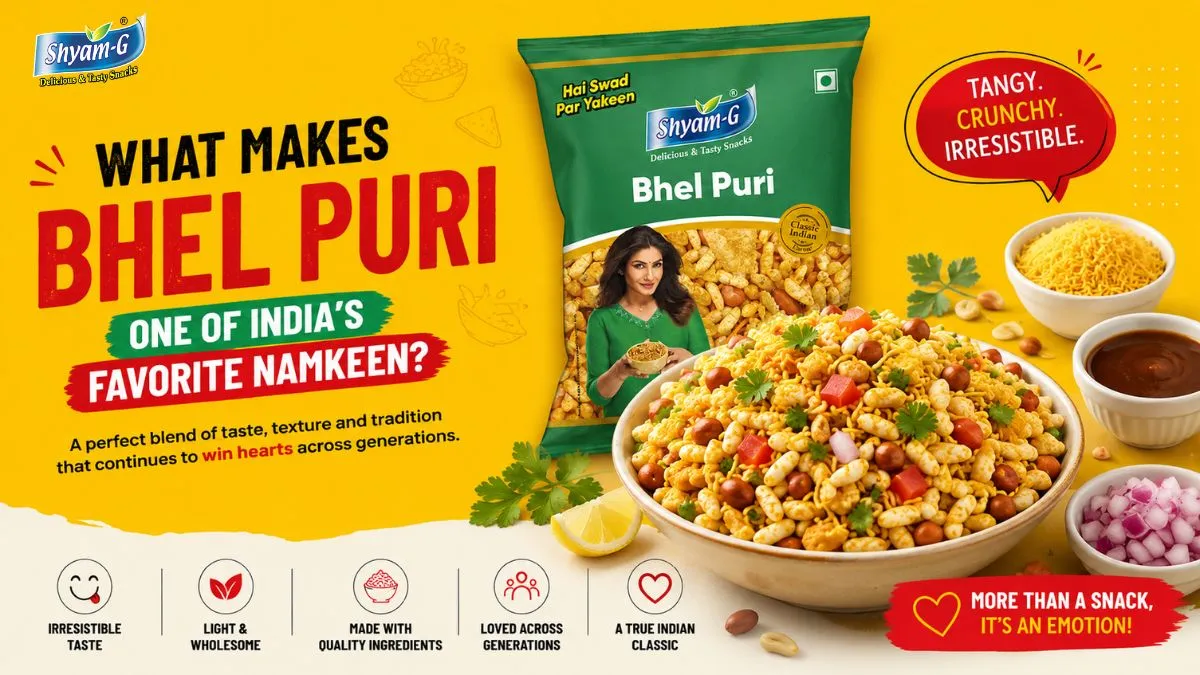
What Makes Bhel Puri One of India's Favorite Namkeen?
Some foods just belong to a place and a feeling. In India, bhel puri is exactly that kind of food. You see it outside railway stations, near college gates, at local fairs, and along busy market streets. A paper cone or a small bowl, filled with puffed rice, sev, onion, tomato, chutneys, and a squeeze of lemon, handed to you by someone who has been making it the same way for years.
Bhel puri is not just a street snack. For millions of Indians, it is a memory, a craving, and a comfort all at once. It is also one of the most interesting examples of a namkeen that has managed to stay popular across generations without ever needing a rebrand or a big marketing campaign.
This article looks at what actually makes bhel puri so special, from its flavor science and history to its regional variations and why it continues to hold its place as one of India's most loved snacks.
What Is Bhel Puri and What Goes Into It
At its most basic level, bhel puri is a mixture of puffed rice, thin sev, chopped vegetables, and two chutneys. One sweet and dark made from tamarind and dates, and one green made from fresh coriander and chili.
But calling it just a mixture snack would be selling it short. The real magic of bhel puri is in the balance of its parts. Every ingredient plays a specific role.
The puffed rice gives it a light, airy crunch that does not feel heavy. The sev adds a thin, crispy texture that mixes into the puffed rice without taking over. The raw onion and tomato bring freshness and a slight bite. The tamarind chutney gives that deep, sweet sourness that coats everything. The green chutney brings the heat and a fresh herby note. And the lemon at the end ties all of it together.
This is not a random combination. Every element in bhel puri has a purpose, and that is part of why it works so well every single time.
The Origin and History of Bhel Puri
The story of bhel puri goes back over a hundred years. It started as a simple, affordable street food that vendors could prepare quickly and sell to large numbers of people at busy public spots like beaches, railway stations, and market areas across India.
The combination of cheap, shelf stable ingredients like puffed rice and sev, paired with fresh chutneys that could be made in bulk, made it a very practical food for street vendors all over the country. No cooking was needed at the spot, no heat, no fire. Just mixing, which meant anyone could set up a bhel puri stall with very little investment.
Over time, bhel puri became deeply woven into the everyday street food culture of India. It was the snack you ate after school, after a film, or while walking through a busy market. It was affordable enough for everyone, which is exactly why it spread so fast and so far across the country.
From coastal cities to inland towns, bhel puri became a common sight at local fairs, evening markets, and roadside stalls. What started as a humble street recipe slowly became one of the most recognized traditional indian namkeen snack formats in the entire country.
Why Bhel Puri Is Loved Across India: The Flavor Science
This is the part most articles skip completely, and it is actually the most interesting part of the whole story.
Bhel puri works so well as a snack because it hits almost every major taste note at once. Sweet from the tamarind chutney. Sour from the lemon and raw mango if added. Spicy from the green chutney. Salty from the sev. And crunchy from the puffed rice.
When your mouth receives multiple taste signals at the same time, it tends to find the experience more satisfying than a single note flavor. This is why bhel puri feels so complete as a snack. It is not just filling you up, it is genuinely engaging your taste buds on several levels at the same time.
This also explains why bhel puri is hard to stop eating once you start. The flavor combination keeps refreshing itself with each bite because the chutneys coat different parts of the mixture differently every time.
As a spicy namkeen option, it also sits in a very comfortable middle ground. It is spicy enough to feel bold but not so intense that it puts off people who prefer milder flavors. This wide appeal is a big reason why it works across age groups from small kids to older adults.
Why Bhel Puri Remains a Traditional Indian Namkeen Favorite
In a snack market that keeps changing, with new flavors, new formats, and new brands appearing every year, bhel puri has stayed completely relevant without trying to reinvent itself.
Part of this comes from the fact that traditional indian namkeen formats like bhel puri carry a kind of cultural memory that packaged snacks simply cannot replicate. When someone eats bhel puri, they are often tasting a memory of a school gate, a local fair, a family outing, or a busy market street in their own town or city. That emotional connection exists across every corner of India, not just in one city or one region.
Another reason is accessibility. Bhel puri is one of the most affordable snacks in India. On a street, a serving costs very little. The ingredients, puffed rice, sev, basic vegetables, and chutneys, are inexpensive and widely available. This means bhel puri has never been a food associated with a particular income group. It is genuinely eaten and enjoyed by everyone.
And because the base recipe is flexible, vendors and home cooks have been able to keep it fresh without changing its essential identity. You can make bhel puri richer with pomegranate seeds, lighter with less chutney, spicier with extra green chutney, or tangier with more lemon. The core stays the same but the experience can be adjusted to suit
Regional Variations of Bhel Puri Across India
This is one of the most fascinating parts of the bhel puri story, and almost no article covers it properly.
Bhel puri looks and tastes different depending on which part of India you are in. Different states and cities have developed their own versions using local ingredients and local flavor preferences, and some of these regional versions are quite different from the version most people know.
In Kolkata, the version is known as jhalmuri. It uses the same puffed rice base but the seasoning is completely different. Mustard oil, green chili, a little raw coconut, and a specific blend of spices are tossed together rather than using tamarind and coriander chutneys. The result is sharper, oilier, and more intensely spiced.
In Karnataka and parts of South India, a version called churumuri uses puffed rice with freshly grated coconut, green chili, raw onion, and a squeeze of lemon. It is lighter and fresher than the more widely known version and has a very different flavor profile.
In Andhra Pradesh, the spice levels in the local version tend to be significantly higher, which reflects the regional love for intense heat in everyday food.
These regional versions show that the bhel puri format is genuinely flexible enough to carry very different flavor identities while still feeling familiar as a mixture snack category across the whole country. anyone.
Bhel Puri as a Khatta Meetha Namkeen: Why the Balance Matters
One of the things that makes bhel puri stand apart from most other snacks in the namkeen category is how well it balances opposite flavors.
Most snacks lean heavily in one direction. Chips are salty. Mithai is sweet. Most spicy namkeen is all about heat. Bhel puri is one of the rare snacks that genuinely earns the description khatta meetha namkeen because it delivers both sourness and sweetness in almost equal measure, with spice layered on top.
This balance is achieved through the two chutney system. The tamarind and date chutney brings sweetness and depth. The green chutney brings freshness and heat. Together they create a layered flavor that no single ingredient could achieve on its own.
For people who do not enjoy intensely spicy food but still want something full of flavor, bhel puri sits in a very comfortable middle ground. It has enough spice to feel interesting but enough sweetness and tang to stay approachable for almost everyone.
Is Bhel Puri a Healthy Snack Option
This is a question more people are asking now that health awareness is growing among Indian snack buyers.
The honest answer is that bhel puri, in its traditional form, is actually one of the more balanced snack options available. Puffed rice is low in calories and fat compared to fried snacks.
The vegetables add freshness and some nutrients. The chutneys, particularly the green coriander chutney, add flavor without adding much in terms of fat or calories.
The less healthy elements are the sev, which is fried, and the amount of salt in the overall preparation. These can add up if the portion is large or if extra sev is piled on top.
Compared to deep fried chips or heavily oiled namkeen, a moderate portion of bhel puri made with standard ingredients is a reasonable snack choice. It is not a health food by any definition, but it compares well to most fried snack alternatives available in the Indian market.
How to Enjoy Bhel Puri at Home
Making bhel puri at home is much easier than most people think, and it gives you full control over the spice level, the salt, and the freshness of every ingredient.
The base ingredients you need are puffed rice, thin sev, finely chopped onion, finely chopped tomato, boiled potato cubed small, fresh coriander, and lemon. For the chutneys, readymade tamarind chutney and green chutney are both widely available at most Indian grocery stores.
The method is simple. Take a large bowl, add the puffed rice, sev, and vegetables. Add both chutneys according to your taste. Squeeze fresh lemon over everything. Mix quickly and eat immediately, since bhel puri loses its crunch very fast once the chutneys are added.
Brands like Shyam G Snacks make the kind of crispy sev and bhujia that work really well as base ingredients in homemade bhel puri, giving you that authentic crunch that is hard to get from softer or stale sev.
The key to good homemade bhel puri is speed. Mix it and eat it straight away. If you let it sit for even five minutes, the puffed rice absorbs the moisture from the chutneys and goes soft, which completely takes away the crunch that makes bhel puri so satisfying.
What Makes Bhel Puri Truly Irreplaceable
After everything, the reason bhel puri holds its place as one of India's most loved namkeen snacks comes down to something simple. It is honest food.
It does not rely on artificial flavoring, heavy processing, or big marketing to make people love it. It works because the ingredients are good, the balance of flavors is genuinely satisfying, and the experience of eating it connects people to something familiar and real.
In a snack market full of new products and imported trends, that kind of honest, time tested appeal is very hard to replicate. Bhel puri has been around for well over a century and it shows absolutely no signs of losing its place on Indian streets or in Indian hearts.What Makes Bhel Puri Truly Irreplaceable
After everything, the reason bhel puri holds its place as one of India's most loved namkeen snacks comes down to something simple. It is honest food.
It does not rely on artificial flavoring, heavy processing, or big marketing to make people love it. It works because the ingredients are good, the balance of flavors is genuinely satisfying, and the experience of eating it connects people to something familiar and real.
In a snack market full of new products and imported trends, that kind of honest, time tested appeal is very hard to replicate. Bhel puri has been around for well over a century and it shows absolutely no signs of losing its place on Indian streets or in Indian hearts.
If you enjoy learning about the stories behind India's most loved snacks and street foods, explore our other food guides for more honest and practical content about Indian snacking culture.
