
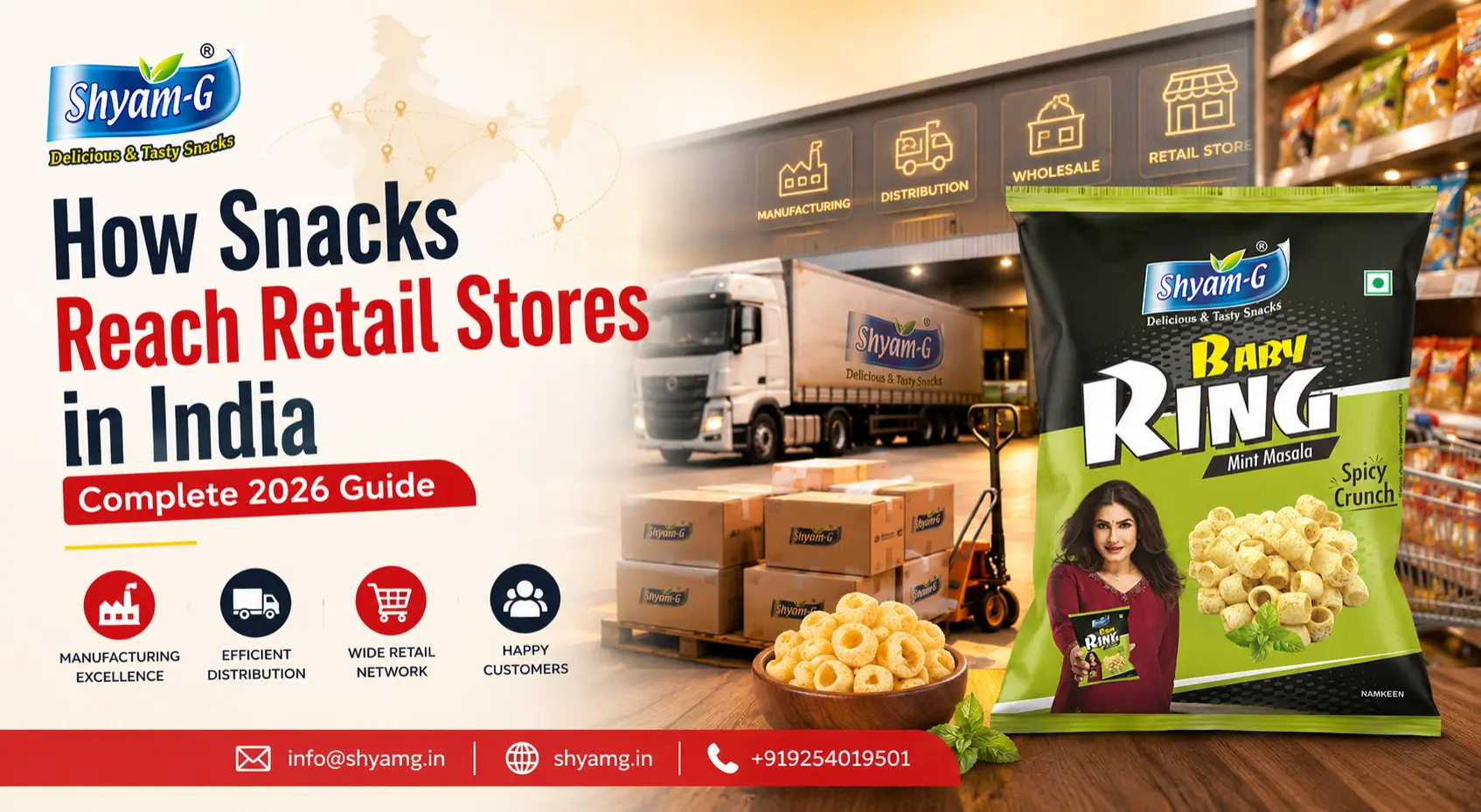
How Snacks Reach Retail Stores in India Complete 2026 Guide
Have you ever wondered how a packet of namkeen, chips, popcorn, or fryums reaches the shop near your home?
The process looks simple when we see a product on a retail shelf. But behind that packet, there is a complete supply chain. The product first comes from a manufacturing facility, then moves through distribution and wholesale channels before reaching the retailer.
Understanding the snacks distribution process is important for retailers, wholesalers, distributors, and businesses planning to enter the packaged food industry.
A good distribution system makes sure that products reach the right stores at the right time and in the right condition. It also helps manufacturers expand into new cities and gives retailers access to products that their customers already want.
For example, a manufacturer may produce namkeen or potato chips in one location, while customers may be buying those products hundreds of kilometres away. Distributors, transporters, wholesalers, and retailers help connect these two sides.
This is why the snack business is not only about manufacturing. It is also about storage, transportation, stock planning, retail relationships, and regular supply.
In this guide, we will explain the complete journey of packaged snacks from the factory to the retail shelf in simple language.
What Happens After Snacks Leave the Factory
Once snacks are manufactured, they still have to travel through several stages before customers can buy them.
A typical journey looks like this:
Manufacturing → Quality Check → Packaging → Distribution → Storage → Transportation → Retail Store → Customer
Each stage has an important role.
If products are manufactured well but distribution is poor, retailers may face stock shortages.
If transportation is delayed, products may not reach stores when customers need them.
If storage is not handled properly, packaging and product quality can be affected.
A strong supply chain brings all these activities together.
This is why businesses looking for reliable snacks manufacturers in india should also understand how the manufacturer's distribution network works.
Step 1: Snacks Are Manufactured
The journey begins at the manufacturing facility.
A professional snack manufacturer starts by selecting suitable raw materials according to the product being made.
For example, namkeen, potato chips, popcorn, fryums, and extruded snacks all have different production requirements.
The basic manufacturing process can include:
➺ Raw material selection
➺ Ingredient preparation
➺ Mixing
➺ Cooking or processing
➺ Shaping
➺ Frying or roasting where required
➺ Seasoning
➺ Cooling
➺ Packaging
Modern snacks factory in india facilities use different machines and production systems depending on the products they manufacture.
The goal is to produce snacks with consistent taste, texture, quality, and appearance.
A manufacturer may produce thousands of packets in a single production cycle. These products then move to the next stage of the supply chain.
If you want to understand this stage in more detail, our guide How Snacks Are Manufactured Complete Step by Step Guide for 2026 explains how snacks move from raw materials to finished products.
Step 2: Products Go Through Quality Checks
Manufacturing does not end when the snack is ready.
Before products move into distribution, manufacturers need to check their quality.
Quality checks can include:
➺ Product appearance
➺ Taste and texture
➺ Packaging condition
➺ Net quantity
➺ Batch information
➺ Date information
➺ Seal quality
➺ Storage condition
Food safety and hygiene are also important parts of responsible snack manufacturing.
This is especially important for businesses working with a snacks manufacturing company india because retailers depend on manufacturers for consistent product quality.
Good quality control also helps reduce customer complaints and product returns.
For a retailer, receiving consistent products from the manufacturer makes stock management much easier.
Step 3: Snacks Are Packed and Prepared for Distribution
After quality checks, snacks are packed for transportation and sale.
Packaging has two main jobs.
First, it protects the product.
Second, it provides important information to the buyer.
A packaged snack may include information such as:
➺ Product name
➺ Ingredients
➺ Net quantity
➺ Batch details
➺ Manufacturing information
➺ Best before information
➺ Customer care details
➺ Food safety information
Good packaging is especially important because snacks may travel through different locations before reaching the final store.
During transportation, products can face movement, heat, moisture, or rough handling. Proper packaging helps reduce these risks.
For a detailed understanding of packaging materials and their role in protecting snack quality, you can also read Packaging Materials for Namkeen and Snacks Complete Guide for 2026.
Step 4: Manufacturers Plan Distribution
Once products are packed, the manufacturer has to decide where they should go.
This is where the snacks distribution process really begins.
A manufacturer may supply products directly to retailers, or products may move through distributors and wholesalers.
The distribution route depends on the company's business model, location, product demand, and target market.
For example, a regional manufacturer may supply nearby retailers directly.
A larger manufacturer may appoint distributors who handle specific cities or areas.
In some cases, wholesalers purchase products in larger quantities and then supply smaller retailers.
This system allows manufacturers to reach more stores without handling every individual retail order themselves.
Why Distribution Matters for Snack Manufacturers
A good product cannot generate sales if customers cannot find it.
This is one of the biggest reasons distribution matters in the snack industry.
A strong distribution network helps manufacturers:
➺ Reach more retail stores
➺ Enter new cities
➺ Maintain regular stock
➺ Reduce supply delays
➺ Build stronger retailer relationships
➺ Respond to market demand
For snacks manufacturers in india, distribution is therefore an important part of long term business growth.
A manufacturer may have a high quality product, but without proper distribution, the product may remain limited to a small area.
On the other hand, a reliable network of distributors and retailers can help a regional snack brand expand into new markets.
How Manufacturers Decide Where to Supply Snacks
Manufacturers do not simply send products everywhere.
They usually consider several factors before deciding where to supply.
Customer Demand
If a particular flavour or product sells well in one city, the manufacturer may increase supply in that market.
Retailer Network
A manufacturer with more retail partners can distribute products across a wider area.
Distributor Availability
Local distributors can make it easier for manufacturers to reach smaller stores and different markets.
Transportation Distance
The distance between the factory, warehouse, distributor, and retailer can affect delivery time and transportation costs.
Product Shelf Life
Manufacturers also need to consider the product's shelf life while planning supply and inventory.
This becomes especially important for packaged snacks india products that are distributed across multiple cities.
The Role of Distributors in Getting Snacks to Stores
Distributors are an important link between manufacturers and retailers.
A snacks distributor india business may purchase products from a manufacturer and then supply them to several retail stores in a specific area.
Instead of a manufacturer managing hundreds of individual retailer orders, a distributor can handle many of those activities within their assigned market.
A distributor may help with:
➺ Stock purchasing
➺ Warehouse storage
➺ Retailer orders
➺ Local transportation
➺ Market coverage
➺ Stock replenishment
➺ Communication with retailers
This makes the distribution system more organised and helps manufacturers focus on production and product development.
Step 5: Distributors and Wholesalers Receive the Products
After manufacturing and packaging, the next important stage is getting the products into the local market.
This is where distributors and wholesalers become important.
A manufacturer may not be able to personally visit every grocery store, supermarket, or local retailer. Instead, the company can work with distributors who manage product supply in a particular city or region.
A Snacks Distributor India business can purchase products from the manufacturer and supply them to many retailers in its area.
Wholesalers can also purchase products in larger quantities and supply them to smaller shops.
This system saves time for manufacturers and makes product availability easier for retailers.
For example, a manufacturer based in North India may work with different distribution partners for Punjab, Haryana, Delhi NCR, and other nearby markets.
The distributor understands the local market, knows the retailers, and can respond quickly when a particular snack starts selling faster.
Step 6: Snacks Are Stored Before Reaching Retailers
Snacks do not always move directly from the factory to the shop.
In many cases, products first reach a distributor or wholesale warehouse.
The warehouse acts as a temporary storage point between the manufacturer and the retailer.
Good storage is important because packaged food needs to remain in suitable conditions until it reaches the customer.
A distributor normally needs to pay attention to:
➺ Clean storage areas
➺ Dry surroundings
➺ Proper stock arrangement
➺ Good ventilation
➺ Protection from moisture
➺ Protection from direct sunlight
➺ Regular stock checking
➺ Proper stock rotation
These simple practices can help maintain product quality during storage.
For a Hygienic Snacks Manufacturer India, quality does not stop when the product leaves the production line. Proper handling, packaging, transportation, and storage also matter.
Step 7: Retailers Place Their Orders
Once a distributor has products in stock, retailers can place their orders.
The order may come from a small grocery shop, supermarket, convenience store, or another retail outlet.
The retailer usually considers several things before ordering.
Which Products Sell Fast
Retailers know which products customers regularly ask for.
If spicy namkeen sells quickly, the retailer may order more of it.
If a particular popcorn flavour is not moving well, the retailer may reduce the next order.
Which Pack Sizes Customers Prefer
Price also affects buying decisions.
Small snack packs may work well in neighbourhood stores, while larger packs may be more suitable for families and supermarkets.
How Much Stock Is Needed
Retailers need enough stock to meet demand without keeping too much inventory.
This is where regular communication with the distributor becomes useful.
A reliable distributor can help retailers maintain a steady supply without unnecessary stock buildup.
Step 8: Products Are Transported to Retail Stores
After receiving the retailer order, the distributor prepares the products for delivery.
The products are loaded carefully and transported to the store.
Transportation may involve local delivery vehicles, depending on the distance and order size.
The goal is simple.
Products should reach the retailer safely, on time, and in good condition.
This stage becomes especially important when a manufacturer or distributor supplies several cities.
A good distribution system helps ensure that products are available when retailers need them.
For a growing Snacks Manufacturing Company India, reliable transportation can make a major difference when expanding into new markets.
Step 9: Retailers Receive and Check the Stock
When the products reach the retail store, the retailer should check the delivery before putting the products on the shelves.
The retailer may check:
➺ Product quantity
➺ Packet condition
➺ Product name
➺ Batch details
➺ Date information
➺ Packaging condition
➺ Ordered items
➺ Damaged packets
Checking the stock helps identify problems early.
If there is a damaged packet or a quantity difference, the retailer can contact the distributor quickly.
This simple process helps maintain a healthy relationship between the retailer and supplier.
Step 10: Snacks Finally Reach the Retail Shelf
This is the stage customers see.
After checking the delivery, the retailer places the products in the appropriate area of the store.
Good shelf placement can make a big difference.
Retailers may place snacks near:
➺ Other packaged food products
➺ Cold drinks
➺ Grocery items
➺ Checkout areas
➺ High traffic sections
Products with clear packaging and attractive designs can catch customer attention more easily.
This is where the entire supply chain finally connects with the consumer.
A product may have started inside a manufacturing facility, passed through a distributor and warehouse, travelled through local transportation, and finally reached the shelf where a customer can purchase it.
How Manufacturers and Distributors Work Together
A successful snack supply chain needs good coordination between manufacturers and distributors.
The manufacturer focuses mainly on production, product quality, packaging, and supply planning.
The distributor focuses on market coverage, retailer relationships, stock movement, and local delivery.
Both sides depend on each other.
A manufacturer needs distributors to reach more stores.
A distributor needs manufacturers to provide quality products and regular stock.
This relationship becomes even more important when a company wants to become one of the Top Snacks Manufacturers in India and expand beyond its home market.
Why Local Distribution Networks Matter
A strong local network can help snack companies grow faster.
Suppose a manufacturer has a good product but has no distributor in a particular city.
The company may find it difficult to reach small retailers in that area.
A local distributor already understands the market and may have relationships with many stores.
This makes market expansion easier.
It can also help a Bulk Snacks Supplier India serve more retailers without creating a completely new delivery system for every location.
For manufacturers, this can mean wider market reach.
For distributors, it can mean access to new products.
For retailers, it can mean better product availability.
What Happens When Distribution Is Not Managed Properly
A weak distribution system can create problems for everyone.
Retailers may face stock shortages.
Distributors may have too much unsold inventory.
Manufacturers may receive fewer repeat orders.
Customers may also move to another brand if their preferred snack is regularly unavailable.
Some common problems include:
➺ Late deliveries
➺ Poor stock planning
➺ Damaged packaging
➺ Poor warehouse management
➺ Incorrect order quantities
➺ Weak communication
➺ Irregular supply
This is why choosing the right manufacturing and distribution partners is important for long term business growth.
Why Reliable Manufacturing Matters in Retail Distribution
Distribution can only work well when the manufacturer provides consistent products.
Retailers want products that customers enjoy buying again and again.
This means manufacturers need to focus on taste, quality, packaging, hygiene, and regular supply.
A company looking for the Best Namkeen Manufacturer in India should therefore look beyond price alone.
The right manufacturing partner should also offer:
➺ Consistent product quality
➺ Hygienic production
➺ Suitable packaging
➺ Reliable supply
➺ Clear communication
➺ Good product variety
➺ Strong business support
These factors can help retailers and distributors build a more stable business relationship with their manufacturing partner.
How Retailers Can Improve Snack Supply
Retailers play an important role in making sure snacks reach customers without unnecessary delays.
A shop can have a good location and regular customers, but if popular products are often out of stock, sales can suffer.
Retailers can improve their snack supply by following a few simple steps.
Keep Track of Fast Moving Products
Retailers should know which products sell quickly and which products move slowly.
For example, if a particular namkeen or chips flavour sells every day, the retailer should inform the distributor before the stock becomes too low.
This helps prevent unnecessary stock shortages.
Order According to Local Demand
Every market is different.
A product that sells well in one area may not perform in another area.
Retailers should study their customers and order products according to actual demand.
This approach can reduce waste and help maintain healthier inventory.
Maintain Good Communication With Suppliers
Regular communication makes the supply process easier.
Retailers should clearly share their requirements with distributors and suppliers.
If demand increases during festivals, holidays, school events, or local celebrations, advance communication can help the supplier prepare enough stock.
How Manufacturers Can Support Retailers
A good manufacturer does more than produce snacks.
The manufacturer should also understand what retailers need to keep their shelves filled.
A reliable Snacks Manufacturing Company India can support retailers through consistent production, regular supply, good packaging, and clear communication.
Manufacturers can help retailers by:
➺ Maintaining consistent product quality
➺ Providing regular stock
➺ Offering different pack sizes
➺ Improving packaging
➺ Supporting distributors
➺ Responding to product feedback
➺ Planning production according to demand
When manufacturers and retailers work together, customers get better product availability and businesses can build stronger long term relationships.
Why Regional Distributors Are Important
Regional distributors are especially useful for snack companies that want to expand into nearby cities and states.
A distributor working in Punjab, Haryana, Delhi NCR, or another region may already have relationships with local retailers.
This makes it easier for a manufacturer to enter that market.
For example, a Snacks Distributor India business can help a manufacturer reach several small stores that would be difficult to manage individually from the factory.
Regional distributors also understand local buying habits.
They know which areas have stronger demand, which products retailers prefer, and when stock needs to be increased.
This local knowledge can be very valuable for growing snack businesses.
How the Distribution Process Helps a Snack Brand Grow
A good product needs good availability.
Imagine a customer regularly buys a particular namkeen brand. If the product is available every time they visit the store, they are more likely to continue buying it.
But if the product is frequently unavailable, the customer may choose another brand.
This is why distribution is directly connected to brand growth.
For manufacturers, strong distribution can help increase:
➺ Market reach
➺ Product availability
➺ Retailer relationships
➺ Repeat purchases
➺ Brand visibility
➺ Sales opportunities
A manufacturer that wants to become one of the Best Snacks Manufacturing Brand in India needs both good products and a reliable supply network.
What Businesses Should Check Before Choosing a Snack Supplier
Retailers and distributors should not choose a supplier only because the price is low.
A reliable supplier should be able to support the business over the long term.
Before starting a partnership, check:
Product Quality
Ask for samples and evaluate taste, texture, freshness, and packaging.
Manufacturing Hygiene
Understand how the products are manufactured and handled.
Production Capacity
Make sure the supplier can manage your expected order quantity as your business grows.
Delivery Support
Ask about delivery areas, expected timelines, and stock availability.
Product Range
A supplier offering several snack categories can make purchasing easier.
Business Communication
Choose a company that responds clearly and supports you when there is a problem.
For businesses searching for a Namkeen Manufacturer India, these points are especially important because namkeen is available in many varieties and pack sizes.
Why Quality and Hygiene Matter in Snack Distribution
A snack can pass through several hands before reaching the final customer.
It may move from the manufacturing facility to a distributor, then to a warehouse, then to a retailer, and finally to the customer.
At every stage, proper handling matters.
Manufacturers should follow suitable food safety and hygiene practices during production and packaging.
Businesses should also understand the food safety requirements provided by the Food Safety and Standards Authority of India.
This is particularly important for retailers and distributors who want to work with an ISO Certified Snacks Manufacturer India or another manufacturer that follows recognised quality practices.
Good hygiene and proper handling help protect product quality and build customer trust.
The Future of Snack Distribution in India
The snack market in India is becoming more competitive.
Consumers now have more choices than before. They can find traditional namkeen, potato chips, popcorn, fryums, extruded snacks, and many other packaged products in local stores and supermarkets.
This means manufacturers need to focus on more than production.
They need a supply network that can keep products available in the right markets.
Technology is also making stock management easier. Businesses can track orders, monitor inventory, communicate with distributors, and understand which products are selling faster.
At the same time, local retailers continue to remain important because many Indian consumers still purchase everyday snacks from nearby grocery stores.
This combination of manufacturing, distribution, wholesale supply, and retail selling will continue to shape the future of the Indian snack industry.
Conclusion
A packet of snacks sitting on a retail shelf has already completed a long journey.
It starts with raw materials at the manufacturing facility. After production, the product goes through quality checks, packaging, storage, distribution, transportation, and finally reaches the retailer.
Every part of this journey matters.
Manufacturers need to produce consistent products. Distributors need to maintain regular supply. Wholesalers need to manage stock properly. Retailers need to order according to customer demand.
When all these parts work together, customers get the products they want at the stores they visit regularly.
For businesses, this is the real value of a strong snacks distribution process.
It helps manufacturers reach more markets, distributors build stronger retail networks, and retailers keep their shelves filled with products customers want to buy.
Looking for a Reliable Snack Manufacturing Partner
A strong distribution network starts with a reliable manufacturing partner.
Shyam G Snacks works with businesses looking for quality namkeen, potato chips, popcorn, fryums, and other packaged snack products.
Our focus is on consistent product quality, hygienic manufacturing, suitable packaging, regular supply, and long term business relationships.
Whether you are a retailer, wholesaler, distributor, supermarket, or a growing food business, choosing the right supplier can make your daily operations easier and help you serve your customers better.
If you are looking for Bulk Snacks Supplier India support or want to build a long term relationship with a reliable snack manufacturing company, Shyam G Snacks can help you explore suitable product options for your market.
Get in touch with Shyam G Snacks today to discuss your product requirements and explore a reliable supply partnership for your business.
